
List Bombing

Published: Nov 19, 2025

List bombing can happen to anyone who has unprotected webforms that collect emails, and can rapidly damage your sender reputation and email deliverability. This article will help you understand what it is, how to prevent it, and what to do if you were a victim of a list bombing attack.
What Is List Bombing?

List bombing is a malicious tactic in which attackers flood your email signup processes — such as newsletter signup forms, or other public form endpoints — with large numbers of unsolicited email submissions. The goal is to overwhelm the owner of a hacked account with hundreds of emails in order to hide purchase confirmations or other transactions like password resets, etc.

These fake submissions can come from bots or malicious actors. Typically, hey use real email addresses (e.g., by abusing aliasing or generating permutations), so the addresses may pass validation.

Why Is List Bombing a Problem

When you send automated emails to the newly added subscribers, including those acquired through list bombing, you risk:

  • High bounce rates because many addresses may be suspended and invalid

  • Increased spam complaints, because the subscriber never opted-in to receive emails from your brand

  • Lower engagement because many subscribers aren’t interested

  • Spam traps: some submitted addresses may be spam trap addresses

  • Blocked or blacklisted sending IPs or domains, if mailbox providers detect suspicious behavior, like sending hundreds of emails to the same address

How to Identify List Bombing

Recognizing a list bombing attack early can help you take action before serious damage is done. Key indicators include:

  1. Sudden Spike in Subscriptions
    A rapid, unexpected influx of new signups — especially when you haven’t launched a campaign — is a major red flag.
  2. Unusual Patterns in Data
    • Submissions clustering within a tight time window
    • Repeating or unusual email domains
    • Strange formatting, like excessive use of .
    • Many submissions coming from the same IP address
  3. Engagement Metrics Are Off
    Among the new subscribers, you may find:
    • Very low or zero opens and clicks
    • High numbers of unsubscribes or spam reports
  4. IP Blocking or Form Abnormalities
    Some email platforms automatically block or flag IP addresses that make a high number of form submissions

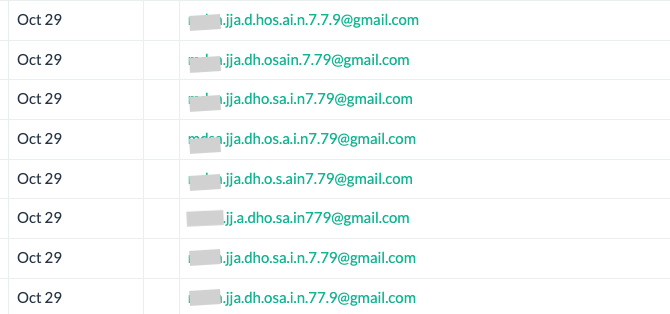
Gmail and Google Apps accounts can have . in an email addrress that are not a part of email ID. So emails John.Smith@gmail.com and JohnSmith@gmail.com are the same email address. In a list bombing attack the same email can be entered with . in many places, to send more emails to the same email. For example, you may see email addresses that look like this jo.hn.sm.ith.81@gmail.com and use an unnatural pattern. This pattern is typically not recognized as a non-unique email address by ESPs and/or verification providers.

Example of emails from  list bombing submissions

Example of email variations that may be entered via a list bombing attack.

How to Prevent List Bombing

Use the following best practices and technical defenses to reduce the risk of list bombing:

  1. Use CAPTCHA on Forms
    CAPTCHA or reCAPTCHA helps ensure that form submissions come from real users rather than automated bots.
  2. Enable Double Opt-In
    Double opt-in requires users to confirm their subscription via email. This blocks attackers who can’t access the confirmation link.
  3. Apply Rate-Limiting or IP Management
    Limit rapid submissions from the same IP or block abusive IP addresses after suspicious behavior.
  4. Add a Honeypot Field
    A hidden field that only bots fill out can help you detect and block automated submissions.
  5. Monitor Deliverability Metrics
    Keep an eye on bounce rates, spam complaints, and engagement metrics to catch issues early.

What to Do If You Suspect List Bombing

If you think your list is being bombed, take the following steps:

  1. Audit Your Onboarding and Signup Flows
    Review all the places where contacts can enter your system — website forms, popups, checkout flows, API endpoints.
    Strengthen any point of entry that might be abused.
  2. Analyze Recent Subscribers
    Identify when the spike happened and evaluate subscribers added during that timeframe. Look for IP patterns, domain patterns, strange names, or other suspicious characteristics.
  3. Suppress or Quarantine Suspected Profiles
    Create a segment of likely fake or malicious signuos and suppress them so they don’t receive future messages.
  4. Clean the Profiles
    Based on your review, either delete or permanently suppress the suspicious contacts. When unsure, suppression is safer than deletion.
  5. Reinforce Protections
    Re-enable or add double opt-in, strengthen CAPTCHA, implement honeypots, and rate-limit or block abusive IPs.
  6. Monitor Going Forward
    After cleanup, closely monitor bounce rate, opens, clicks, and complaint metrics to detect any recurring issues.

Key Takeaways

  • List bombing is a serious threat to deliverability, sender reputation, and data integrity.

  • Preventive measures like CAPTCHA, double opt-in, honeypots, and rate-limiting are crucial.

  • If attacked, isolate and suppress suspicious profiles quickly, then reinforce security everywhere contacts enter your system.

If you are a BigMailer customer who suspects list bombing attack is in progress reach out to us via chat to see how we can help.

Always monitor your campaign engagement and strive to improve email deliverability to make the most of your email program, and to prevent any long-term performance issues.